

Learn how to build a custom marketing funnel that reflects your real customer journey – giving you a strategic roadmap for the year ahead
A custom sales funnel is one of the most powerful diagnostic tools in the marketing arsenal. So why are we still using generic funnel templates like AIDA (awareness, interest, desire, action) and TOFU/BOFU?
These templates can be useful as a guide; most customer journeys begin with awareness and end in purchase or action. But taken wholesale and applied to your business, these off-the-shelf models will – with 100% certainty – overlook crucial steps in your customer journey.
There is no cut-and-paste marketing funnel that can do the job as well as you can. It doesn’t exist, because every business is unique with its own quirks and bottlenecks.
In a subscription category like streaming, the funnel might be short and cyclical, with trial and churn as important as acquisition. In luxury goods, the process could take months or years, with emotional validation and justification hoops to jump through before a buyer makes it to purchase.
For some brands, NPS or advocacy is critical to long-term growth and so might be the final stage of their funnel. For others, a sale at the bottom is all that matters.
Generic funnels flat-out ignore these differences. They assume buying behaviour is linear, rational and homogeneous across every brand and category.
It’s only by building a custom funnel that we get a true picture of what’s really going on. Market research can uncover the idiosyncratic twists and turns of our customers’ journey, then our sales data can pinpoint exactly where we’re losing people along the way.
brands must start using custom funnels if they are serious about marketing excellence
If Mark Ritson has one key lesson from the Objectives module on the MiniMBA in Marketing, it’s that brands must start using custom funnels if they are serious about marketing excellence.
Once built, that funnel becomes a strategic roadmap, enabling marketers to select the right data-driven objectives for the year ahead – those that give us the best chance of measurable business impact in our next marketing cycle.
To understand more about the role of custom funnels in marketing objectives, read "Objective setting is the most important part of the marketing journey"
How to build a custom marketing funnel in five steps
The nature of a custom marketing funnel is that it’s your own, so no one (including Mark Ritson) can tell you exactly what yours should look like. However, we can outline the five basic steps.
Mark says, “Don’t listen to any of the experts, including me. Build your own. It doesn’t have to be perfect, but it will be a lot better than any generic suggestion that anyone else has made.”
-
Step 1. Define your total potential market
Begin by identifying the total size of your market. If you’re following the MiniMBA framework, you’ve already done that back in Module 3: Segmentation.
This is the broadest view of potential customers – everyone who could sensibly buy your product or service. For toothpaste that could be everyone with teeth. A specialist toothpaste brand might define their total market as every UK adult who experiences tooth sensitivity.
This is your 100%. Put that number at the very top of your funnel. At each subsequent step, the number of customers making it through will be a percentage of that original 100% or ‘total market base.’
Remember, the aim of the funnel is to capture a mirror image of how consumers are moving from the market down into your funnel and all the way through to purchase. So always do what feels right – and most useful – for your particular marketing plan.
-
Step 2. Plug the bottom of your funnel with sales data
Using internal data – sales records, CRM insights, website analytics, customer research – plug the bottom of your funnel with the number of customers who reach your desired outcome. This is usually a sale, but it could be loyalty or repeat purchase behaviour.
Looking at MiniMBA, for example, around a third of alumni go on to book a second course. That tells us, along with our customer research, that the experience of doing one MiniMBA course is a significant step in the customer journey. It therefore makes sense to include both ‘booked course’ and ‘booked course #2’ as the final two stages of our funnel.
Whatever number is at the bottom of your funnel, it should be a far cry from that meaty total market base number at the top – our 100% of potential customers.
So, now we can start asking ourselves: where did all those customers go?
we can start asking ourselves: where did all those customers go?
-
Step 3. Map your customers’ movement
Here’s where we add our intervening funnel stages. Use qualitative research to identify the main steps your customers pass through on their buying path, from awareness to purchase (or repurchase and advocacy, et cetera).
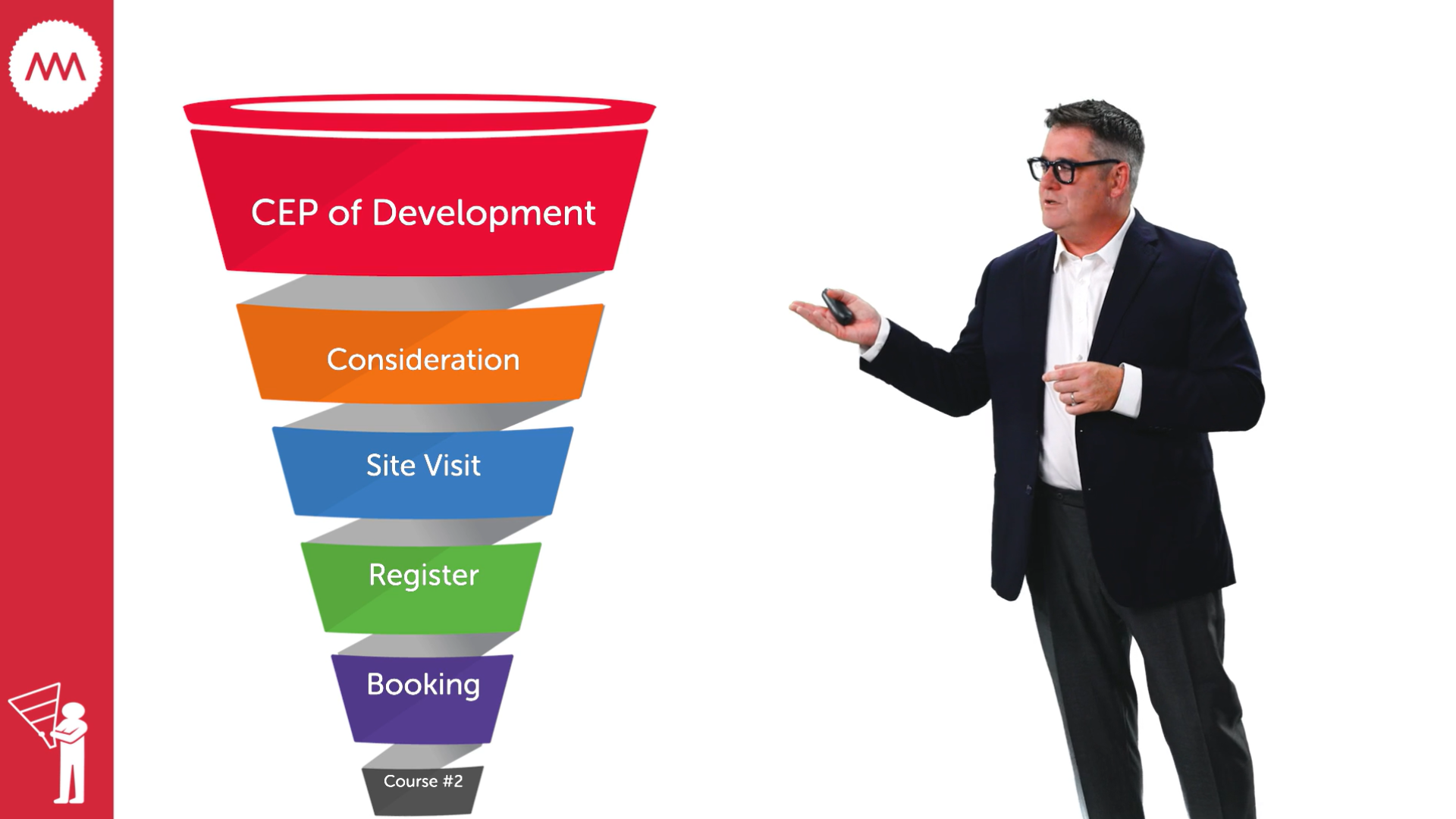
Qualitative surveys, interviews or focus groups with recent customers are all great ways to draw out those specific steps in your customer journey.
Keep it simple, but specific. Your funnel stages can be whatever you want, as long as they are relevant and represent a stage in your buying journey. Instead of brand awareness, for example, the MiniMBA funnel starts with a category entry point (CEP) of career development. Netflix’s funnel has ‘Watch Netflix’ as the funnel stage before ‘Subscribe to Netflix,’ because it captures the reality of password sharing and household access before customers eventually go on to purchase their own subscription.
Your funnel should capture the nuance of your buying path, but not in so many stages that you can’t see where the bottlenecks are. “You don’t get extra points for having more stages,” says Mark. The purpose of the funnel is to diagnose problem areas, so we can make big strategic choices about how to address them later on.
-
Step 4. Populate your funnel with data
We know the number at the top, our total market population, and we know the numbers at the bottom thanks to our customer sales data.
Now, using quantitative market research, we must populate those gaps in the middle by estimating the proportion of people moving through each stage.
Again, if you are following the MiniMBA in Marketing framework, your quant brand survey back in Module 2: Market Research will have given you all the data you need to populate the behavioural stages of your funnel, including awareness, alternatives and interest metrics.
Otherwise, run a funnel survey among a representative sample of your total market population and extrapolate those numbers to give you your funnel percentages.
It doesn’t need to be an exact science
Next, we can turn to our internal data to fill out the remaining funnel stages. It doesn’t need to be an exact science, but use all your different data points to make the closest estimate you can.
Finally, we have our populated custom funnel. For the first time we can see what percentage of our total potential market is making it through each stage of our funnel.
-
Step 5. Run your conversion statistics
The final but critical stage is to work out your customer conversion at each stage of the funnel. Otherwise, our percentages can be misleading.
Using the MiniMBA funnel example again, if you look at 7% consideration in isolation, out of 100% UK marketers that sounds pretty shoddy.
However, when you factor in conversion from the previous stage – brand association with CEP of Development (12%) – that means that 58% of those customers who know us consider us. Not so bad after all.
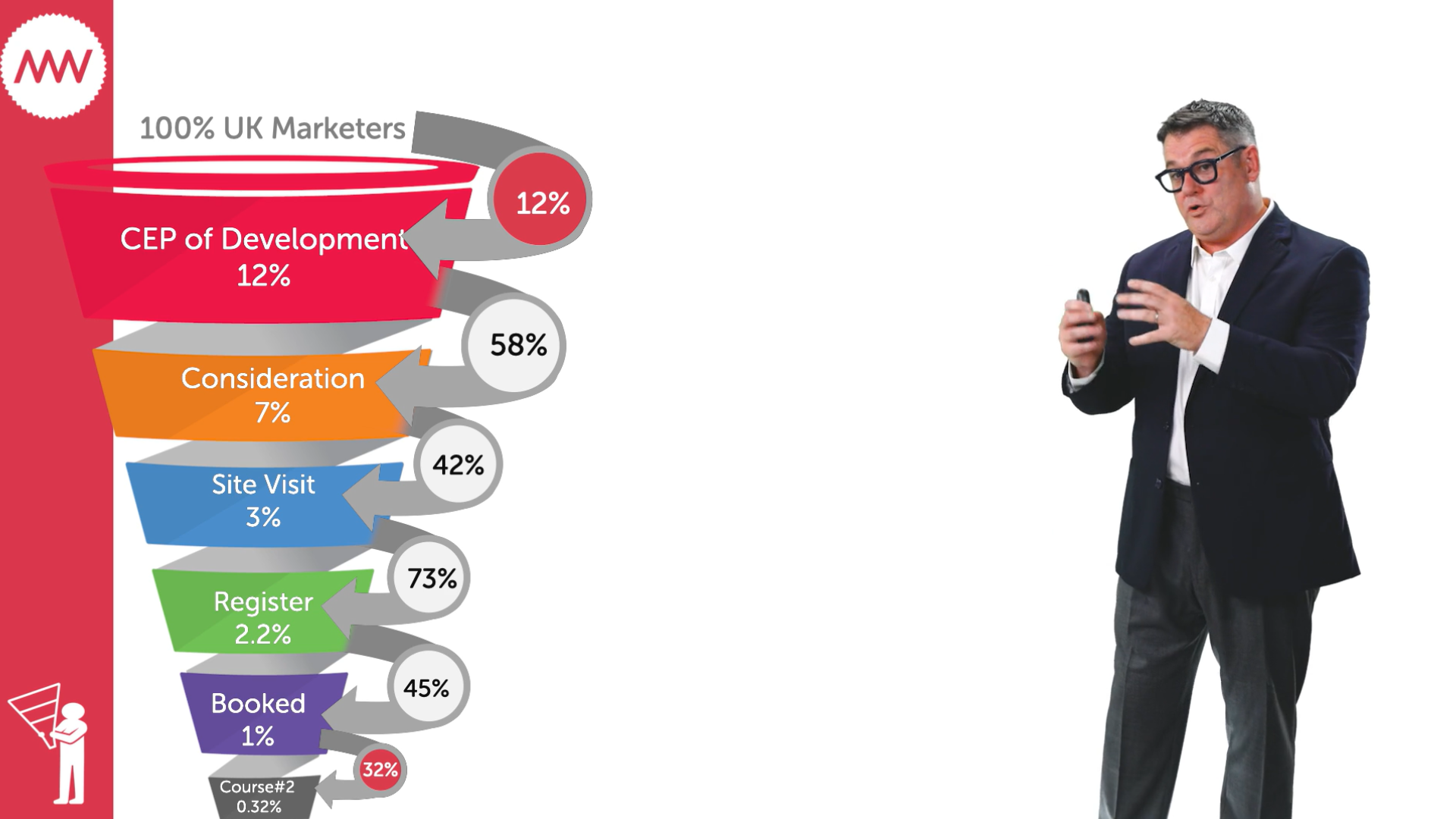
These conversion numbers are how we locate the leaks in our funnel, so we can go on to set strategic objectives that result in more customers making it through our funnel, giving us more sales at the bottom.
Using the funnel to drive strategy
So, we’ve built our custom funnel in five relatively easy steps, but the real work begins with funnel analysis. Again, the funnel isn’t a marketing diagram – it’s a diagnostic tool that we use to choose objectives and therefore drive strategy.
We can see where we’re losing customers, but now we have to figure out why
With our conversion insights from the funnel, we can now do a bridge analysis by digging into our market research to figure out what’s going wrong. We can see where we’re losing customers, but now we have to figure out why.
You may also want to bring in competitor analysis to see how you’re performing at each funnel stage relative to the market, which can reveal a very different picture to the one we started with.
For a deep dive into marketing funnels and objectives, sign up for the next MiniMBA in Marketing course. Mark Ritson will take you step by step through the how and the why of custom funnel building, with plenty of real-world examples including B2B, mass market vs target segments and more.
The quotes from Mark Ritson in this article are taken from Module 6: Objectives in the MiniMBA in Marketing.
Cover: abu / Adobe Stock