
That might sound like hyperbole, but setting a data-driven goal and achieving it is marketing excellence 101. A successful product launch or a brand campaign that boosts awareness by 20% might feel like a bigger, more exciting win. It might even have more obvious impact. But is that success repeatable? Can you show that it wasn’t a fluke?
Marketing effectiveness is about setting a measurable objective – one that specifically answers your existing business needs – and taking the right steps to get there.
On the MiniMBA in Marketing, objectives are the conclusion of strategy: they bridge the what and the why, before we move onto the how. Because before jumping into tactics, we need to know what success looks like.
Funnels feed objectives
When we talk about objective setting, we’re really talking about analysing our sales funnel and using that information to choose marketing objectives that will give us the greatest business impact.
“We obsess month by month, year by year, with our performance in terms of our sales numbers. Did it go up? Did it go down? And although our sales chart is very important, because it’s the lifeblood of a business, it’s also relatively useless,” says Mark Ritson.
“You can look at your sales performance chart for hundreds of hours and it doesn’t really tell you anything other than your relative revenues. It doesn’t explain anything. The funnel replaces the sales chart and gives us a more diagnostic point of view.”
The funnel replaces the sales chart and gives us a more diagnostic point of view
If there’s one key lesson from the Objectives module on the MiniMBA in Marketing, it’s that you cannot lift a generic funnel from your marketing textbook and apply it wholesale to your business, because you will miss steps that are crucial in your customer journey.
Awareness and consideration are important, but what happens to those consumers who fall out of your funnel before preference and purchase? Or repeat purchase and advocacy?
Instead, we can take those sales numbers and put them at the bottom of our funnel, then build a custom sales journey by filling in the specific steps between those customers who purchase and the total potential market – our 100%.
For each stage, add your market research and sales data, then work out what percentage of people are moving from one stage of the funnel into the next.
Once we understand where those customers are going, we can begin to fix those leaks – i.e. go after strategic objectives that result in more paying customers at the bottom.
once we understand where customers are going, we can begin to fix those leaks
This isn’t a mammoth task. And you don’t need to pay a research agency to go away and do it for you. If you’re doing the marketing cycle properly – diagnosis, then strategy, then execution – you already have everything you need to build, populate and do a bridge analysis of your custom funnel to derive data-driven objectives.
“Don’t listen to any of the experts, including me,” says Mark. “Build your own. It doesn’t have to be perfect, but it will be a lot better than any generic suggestion that anyone else has made in a different category or completely different universe.”
For an introduction to custom funnel building, read: “Stop using generic funnels – here’s how to build your own”
How Netflix uses the funnel to drive strategy
To understand the practical application of funnel-based objectives, Mark digs into a brilliant case study from Netflix.
Looking back to 2019, when less than half of UK households watched Subscription Video on Demand (SVOD), funnel analysis showed Netflix that their biggest drop-off (and therefore opportunity) was the 53% who weren’t watching any SVOD at all.
So rather than spending communications dollars on convincing the unconvinced to subscribe to Netflix, or clamping down on password sharing, Netflix did the opposite. Their objective was to get more households watching SVOD – and if that meant using other people’s accounts for free, even better. Call it a nationwide free trial.
Expressed as a SMART objective, that looked something like this: Increase the proportion of British households that watch SVOD from 47% to 75% by December 2021.
Once those non-watchers became watchers, they fell into the next stage of the funnel: ‘Watch Netflix’. At a later date and further down the funnel, Netflix could then try and convert those people into paid subscribers.
Once those non-watchers became watchers, they fell into the next stage of the funnel:
A couple of years on, as many remember, that’s exactly what Netflix did. Suddenly we were greeted with a firm but fair telling off once we tried to sign in with our stolen password, or messages from friends and family asking if we’d changed our account.
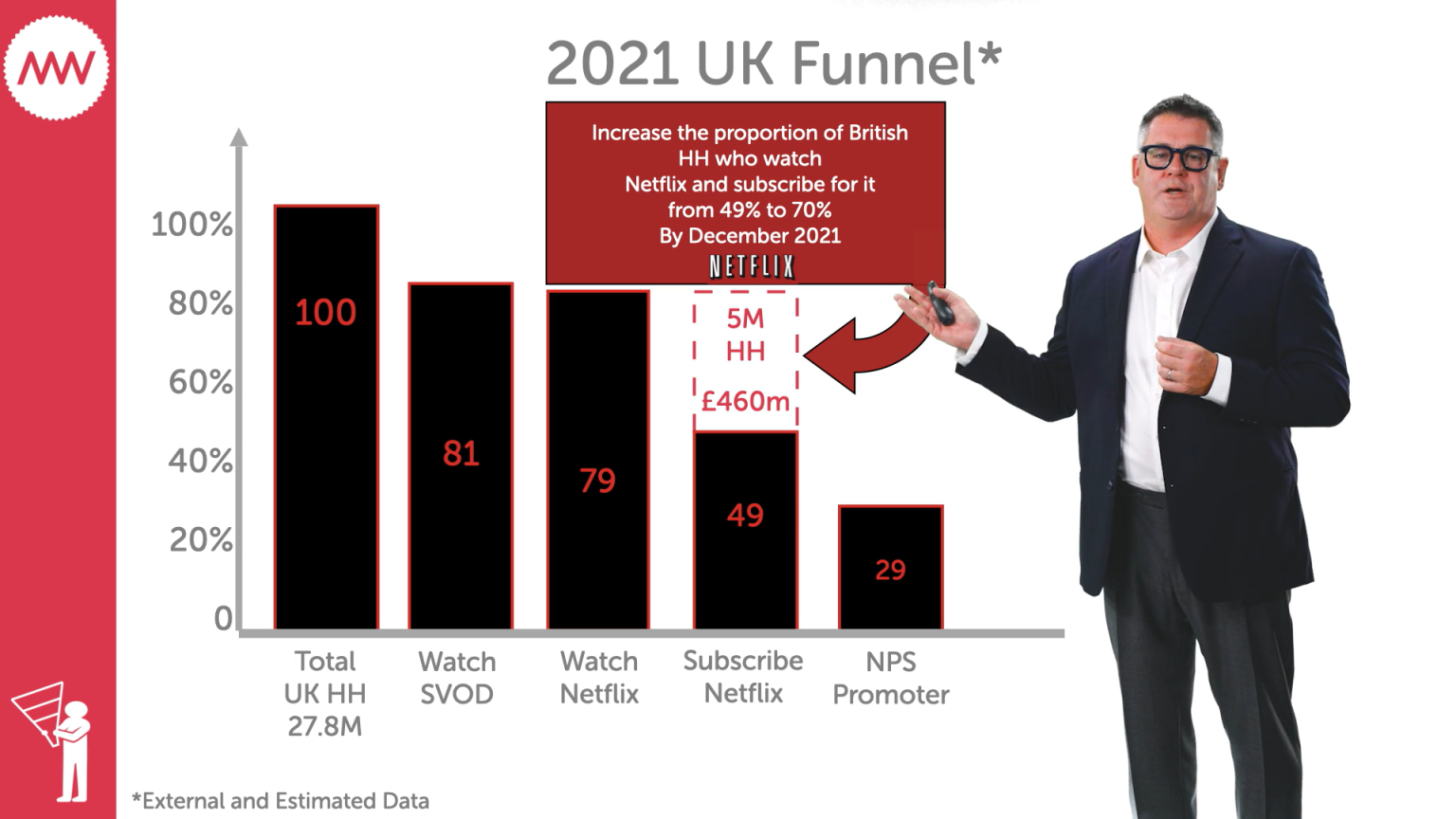
Netflix has presumably always had this capability, so why now? After surpassing their objective to get more of us watching SVOD, Netflix still pretty much owned the market (with 79% of the now 81% SVOD-watching UK households viewing Netflix).
And so, a fresh analysis of the Netflix funnel in 2021 showed that their biggest opportunity now was those non-subscribed watchers. The smartest thing for the business to do was focus on converting those watchers into paying customers.
E.g. Increase the proportion of British households who watch Netflix and subscribe for it from 49% to 70% by December 2021.
An analysis of the funnel today would more than likely spotlight a different objective. That could be getting more subscribers onto their premium subscription tiers, or even refocussed efforts on consideration and preference, as Netflix fights off increasing numbers of insurgents like Disney+ and Paramount+.
Choosing the right objectives
Which leaks in your funnel you choose to go after will depend on a number of things. It might be immediately obvious where you’re losing customers, or you might find several holes that need attention. You’ll also need to factor in time, capabilities and resources.
Your objective might be a top of funnel objective – raise brand awareness in the Americas from 23% to 30% by September 2025. If data suggests you have saturated your existing market and you’re converting well at each stage of the customer journey, the funnel will tell you the best strategic play is to get more consumers in at the top.
But other times, it won’t be the smartest move to shove more consumers through your funnel, only to lose them – potentially forever – later on. If nothing else in the business changes, you’ll still see more sales at the bottom. The business will still celebrate your brilliant marketing efforts and resulting profit. But could you have seen better, compounding results by focussing your efforts further down the funnel?
For example, a SaaS company seeing low subscription renewals or rollout, a better objective might be: Increase demo engagement from 20% of new customers to 50% of new customers by January 2026.
The beauty of building a custom funnel and filling it with real customer data is that it will tell you, plainly, where to focus your attention to create the biggest business impact.
look at your funnel data in the context of the wider market
However, this comes with two important caveats. First, you must look at your funnel data in the context of the wider market. After building your own funnel, a competitor analysis can give you a fuller picture of the whole story. As part of your earlier diagnosis work, you should have also collected survey data on your competitors. This gives you the ability to compare your own funnel data against theirs.
What might at first appear to be a weak conversion point, relative to the market, you’re actually doing well. Perhaps more importantly, the opposite is true too. Using an example funnel for MiniMBA, Mark shows how this might play out.
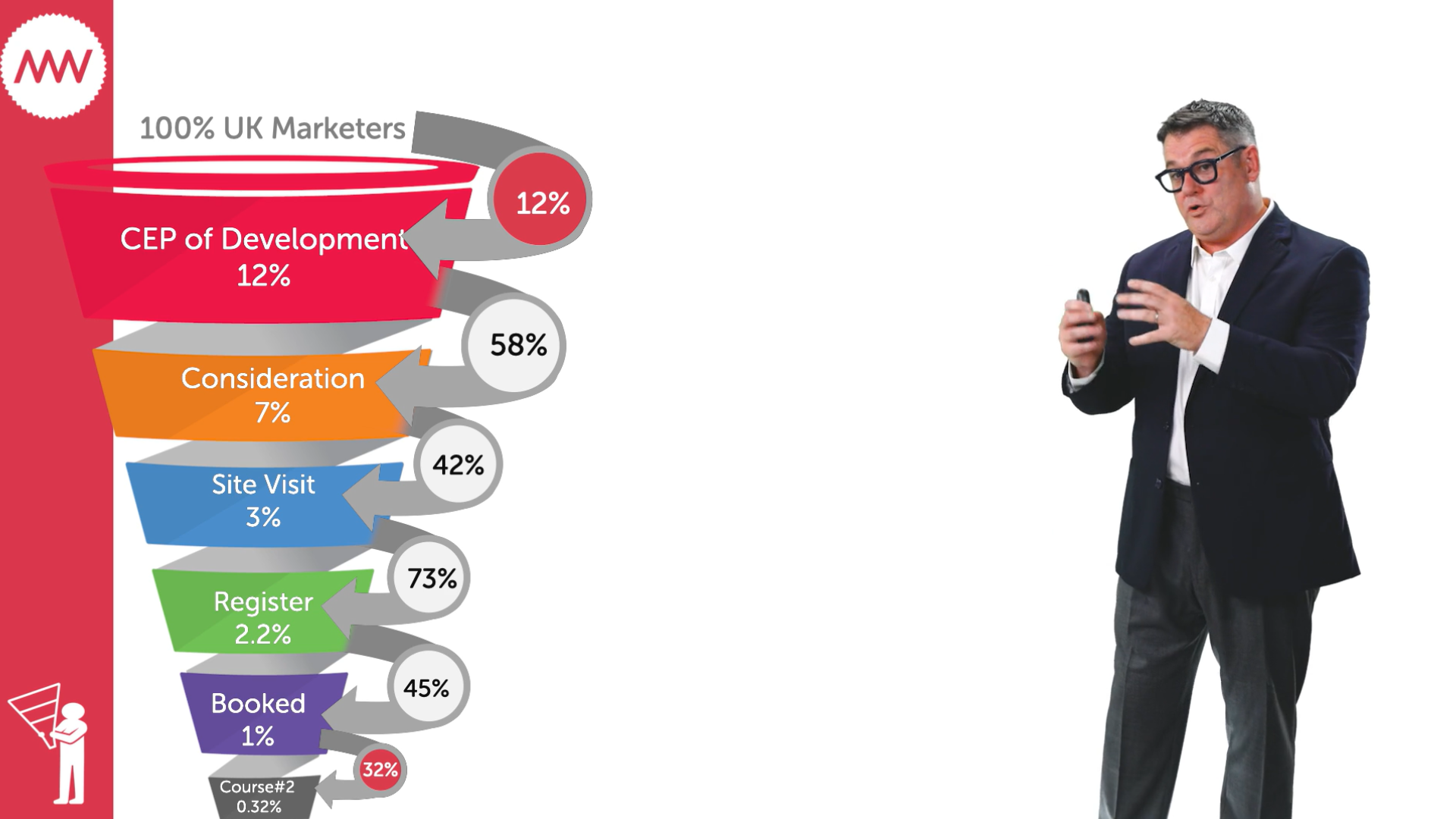
At first glance, moving 58% of consumers from the first stage of the funnel (a category entry point of career development) through to the next stage (consideration) seems pretty good. It’s certainly not the most obvious leak in the funnel.
However, once you add competitor data, we’re looking at a different story. Competitors might have less association with the CEP of career development, but they are converting 72% of that pool into the consideration stage.
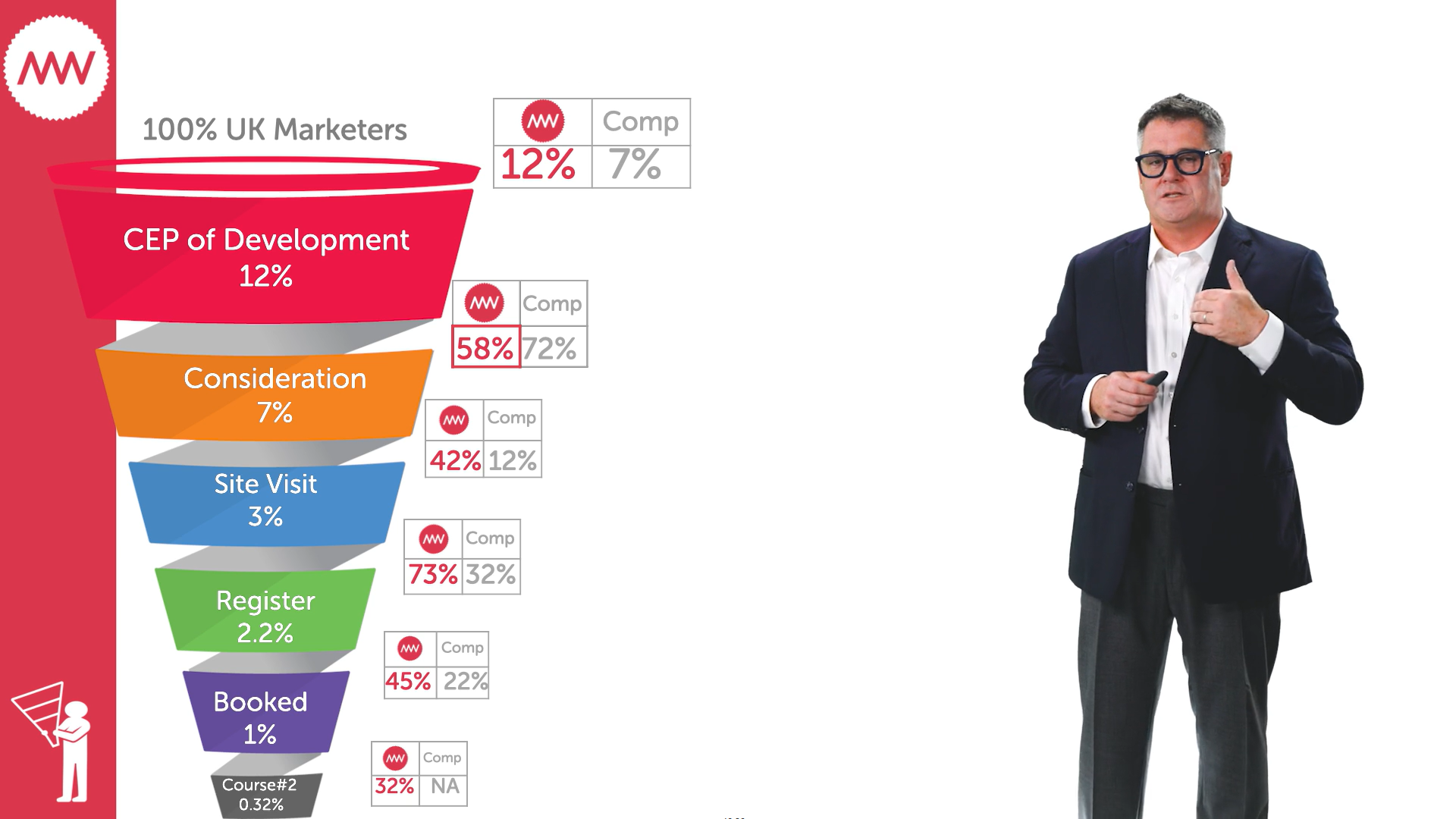
Now, with this new insight from the funnel, we can do a bridge analysis by digging into our market research to figure out what’s going wrong. Some of those things will be actionable and can feed our strategic objectives, others might not be.
As much as the funnel can tell us where we’re losing customers, you need to interpret that information to work out which stage of the funnel is the best place to focus your marketing resource for the year ahead.
This brings us onto the next important caveat. Which holes in the funnel are the hardest or easiest to fix? Mark Ritson uses the analogy that the customer journey is like a leaky water pipe. You want as much water to make it through the pipe as possible, but you have a limited amount of time and money to fix the problem.
Mark says, “I’m probably going to choose two kinds of holes. First of all, the biggest holes. And second, the ones that are easiest to fix. As a result of that, I’m going to see a lot more water coming through my pipe. And maybe on my next visit, I can choose other holes to fix.”
Don’t spread your marketing money across all the steps of the funnel
“Don’t spread your marketing money across all the steps of the funnel. Choose the one or two steps that have the most potential and invest everything in them. There will be other years and other opportunities – for now, make big choices.”
You can learn more about strategic objective setting – including how to build and analyse your own custom funnel, dive into bridge analysis, and turn diagnosis into data-driven strategy – on the MiniMBA in Marketing.
Mark Ritson takes you step by step through the tools and frameworks that underpin marketing excellence, equipping you to make bigger, smarter choices that deliver measurable impact.
The quotes from Mark Ritson in this article are taken from Module 6: Objectives in the MiniMBA in Marketing.
Cover: Sammby/shutterstock.com