

Mark Ritson has been on a public crusade for unity among the marketing discipline. He’s even reached out to the father of distinctiveness himself, Byron Sharp, to agree terms…
But in the meantime, we have to deal with a few synonyms. Distinctive Brand Assets (Ehrenberg-Bass Institute), Fluency (System1) and Brand Codes (MiniMBA) all mean the same thing: How quickly and easily do consumers recognise a brand and its assets? Logos, sounds, characters, colours, et cetera.
What everyone is in agreement about is that brand codes are vital for brand growth. Whether you are a challenger brand or an industry leader, brand codes matter. Brands must work hard to stand apart from competitors, certainly. But first, they must stand out and be distinctive.
“Distinctiveness has got nothing to do with competitors,” Mark says. “It’s all about how I stand forward in your consciousness, so you know that it’s me. It is, as Byron Sharp says, how a brand ensures that it looks like itself.”
You can learn more about brand codes and what strategic function they serve on the MiniMBA in Brand Management.
Read next: Brand Codes: “First, they must know it’s me”
But where do brand codes actually come from? Coca-Cola’s contour bottle was famously inspired by the kola nut from which it was originally made, whereas Veuve Clicquot’s now-signature yellow label was the result of a printing mishap. The point is codes themselves can come from anywhere.
“Some codes aren’t meaningful,” says Mark. “They’re just stuff that got attached to the brand and became part of the associated network in the head of the consumer. If the code evokes the brand, if the code makes the brand distinctive, we’ll take it … as long as it makes the customer notice me.”
If the code makes the brand distinctive, we’ll take it … as long as it makes the customer notice me
That stuff – the visual, aural and other sensory cues that evoke a brand – is carefully refined and then pulled together into a “palette of codes.” Going forward, those elements are quite literally how the brand manager will paint the brand across every touchpoint to build distinctiveness.
Using his own consultancy work for Sephora as an example, Mark shows us what a refined palette of codes looks like. We can recognise the logo, the wave, the black and white stripe, and the touch of red.
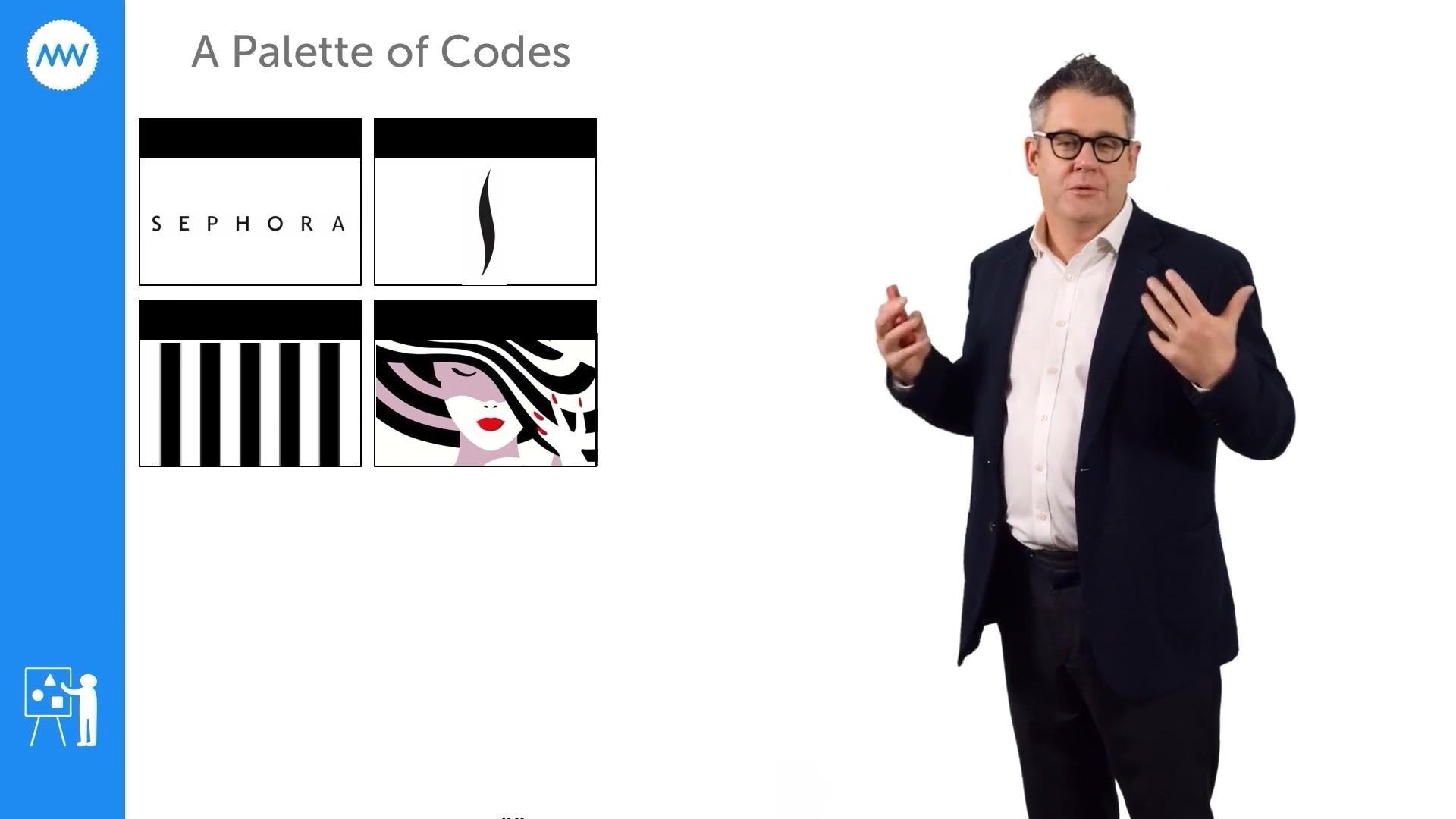
“That doesn’t look like much,” says Mark. “A huge billion-dollar brand like Sephora has only four codes. What you learn as you execute codes is that three or four, maybe five, codes is really the maximum number you want to create a very distinct environment for your brand. Because how you use these different symbolic assets can be extraordinarily different.”
Take a look how Sephora sprinkles each code throughout this short ad –
Choosing the right brand codes
Mark always recommends a brand’s history as fertile ground for Brand Diagnosis work. And again, with brand codes, he says the archives are often your best resource.
“Whether you’re 20 years old or 200 years old, you’re going to dig through your history to try and identify anything that might possibly be a code of your brand.
“This is akin to being dealt codes from the hand of history. You’ve been given stuff by accident, deliberately, products have been designed, ads have run, things have happened, stuff has become attached to your brand that the customer might recognise.”
stuff has become attached to your brand that the customer might recognise
In 2020, for example, Asda permanently revived its ‘pocket tap’ brand code – first aired in 1977. It doesn’t make logical sense in a contactless world, where we’re more likely to misplace our last trolley pound than put change in our back pocket during the weekly shop. But the gestural code is so ingrained in consumers’ minds that the brand team brought it back as part of a long-term strategy to reclaim their place as the supermarket of value.
You can go back further and look for inspiration from founders (Coco Chanel and minimalist personal style), brand heritage (Barbour and its official ties to the British Royal Family) or location (Donna Karan New York).
Start with a long list; codes you may already be using and any you’ve uncovered in your brand research, Mark says. Because the next stage is when we’ll whittle it down to the few codes that give us the best chance of creating distinctiveness in the market.
If the discovery stage seems a bit soft, “the selection process becomes very strategic – and very important to the long-term success of your brand,” says Mark.
But before you take your list of potential codes out to qual and quant, Mark recommends you begin the selection process with a trip to the art department. He says, “The first place I always turn is to creative people. The best people to give you a sense of what will or won’t work in the future is usually the creative team. Ask them to tell you which of these codes has the most legs in terms of being applied and having impact.”
Now, with our remaining brand codes, we can do some qualitative consumer research. A good – and extremely effective – shortcut, says Mark, is to talk to your loyalists. “Asking loyalists about the brand is a great way to mainline the brand image and find it very quickly.
Asking loyalists about the brand is a great way to mainline the brand image
“Ask loyalists what images, associations, little tricks and twists instantly tell you this brand is here. Loyalists can always spot, straight away without the logo, the existence of your brand because they recognise certain codes.”
And if you really want to get into it, says Mark, we can then take our codes out to quant. The brilliant Professor Jenni Romaniuk literally wrote the book on it. The most well-known and practical methods for measuring brand codes is her fame/uniqueness axis.
“The work of Jenni Romaniuk is fantastic and she details in this wonderful book, Building Distinctive Brand Assets, how you can quantitatively measure codes in order to work out which ones that you’re going to play.
“In a reversal of the traditional approach to brand research, Romaniuk advises that you don’t start by asking if consumers are aware of a brand. Instead, she starts with the code and sees how many consumers, in an unaided fashion, can associate that code with a certain sponsoring brand.”
The brand asset scores can then be plotted on an X and Y axis for ‘fame’ and ‘uniqueness’ to create what Romaniuk calls the Distinctive Assets Grid.
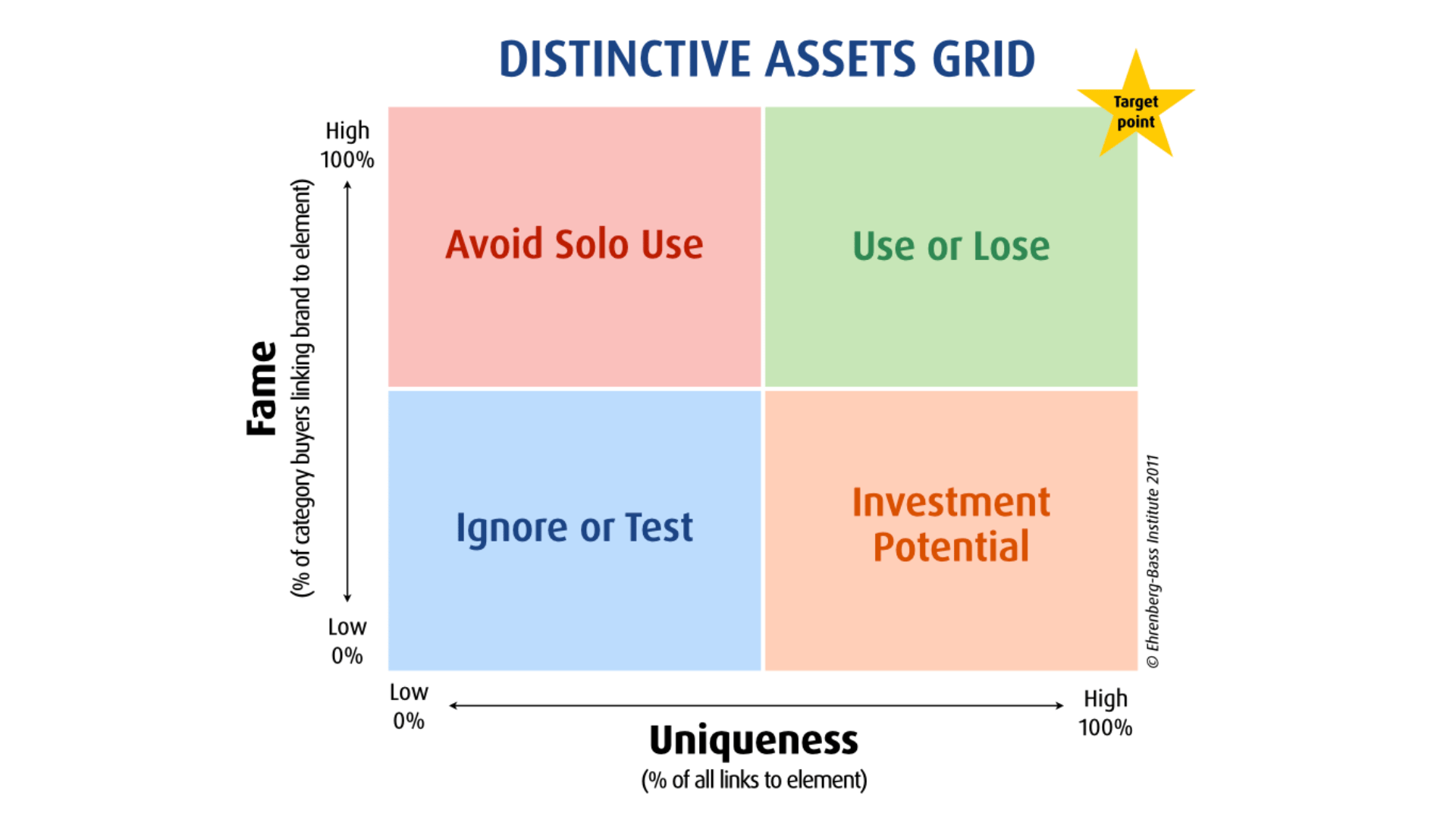
Taking Ferrari as an example, if you were one of the consumers being tested, you might be presented with a specific red Pantone and asked the question: Which brand or brands come to mind when you see this colour? If 85 of 100 customers said Ferrari, that would give you an 85% fame score.
But a proportion of consumers who mentioned Ferrari could have also mentioned a selection of other brands that this particular red evoked. If we assume that only 5% of the sample exclusively mentioned Ferrari, that gives you a uniqueness score of 5%. Putting Ferrari’s famous ‘Rosso Corsa’ red squarely in the ‘avoid solo use’ box.
In contrast, we can look at the original Coca-Cola contour bottle. Market research back in 1949 showed that 99% of the population associated it with Coke and only Coke. Putting it smack in the top right corner of Romaniuk’s ‘use or lose’ quadrant. “It was, frankly, perfect,” Mark says. “We are looking as much as possible for the codes that sit in that particular quadrant.”
It was, frankly, perfect
On the bottom left of the grid, we also have a quadrant for low fame, low uniqueness assets that Jenni Romaniuk has generously called ‘ignore or test.’ Realistically those codes should go straight in the bin.
And finally, codes that are unique but not highly associated with your brand. “Romaniuk would call that a code that has ‘investment potential’. If we can make it more famous, if we can invest more money in it, it has the potential to be a future code of use. But the reality is, at least in my experience, we’re looking for that top box. We’re looking for things that already have fame and uniqueness. They’re the ones that we’re going to select for our palette.”
You can get ever more empirical. “Romaniuk lays out in that wonderful book – and I do recommend it – a much more scientific way of making those selections and doing the analysis,” says Mark.
But many brands won’t need or want to go that far. Because the most important thing about brand codes is that you start using them. Applying your codes over and over and over again, across every consumer touchpoint, is what makes a brand begin to look like itself.
the most important thing about brand codes is that you start using them
Only once you’ve succeeded at being quickly and easily recognisable to consumers can you then start reaping the other benefits of brand codes.
Ferrari’s distinctive red might evoke passion or fearlessness – but it doesn’t do that job on its own. Otherwise, we would get excited at the sight of a British post box. It’s through constant application of your combined palette of brand codes, and then through the bigger work of positioning, communications and everything else above the waterline that meaning is imbued.
Brand codes join the dots and tie everything back to your product so the consumer can first notice and then understand your product – increasing the likelihood they’ll go on to purchase, and create profit and growth for your brand.
The quotes from Mark Ritson in this article are taken from Module 6: Brand Codes in the MiniMBA in Brand Management.
Cover: cienpies/Getty Images