

Understanding the marketer’s “prime directive.” Why listening to consumers matters (and why it’s not as simple as it sounds)
When we hear about customer-centricity, we might think of Bezos’ mantra of “customer obsession” at Amazon, or Netflix’s hyper-personalisation and consumer-led content creation. But being customer-centric is more than a buzzy adjective or Silicon Valley mindset, it’s a strategic business approach that’s been at the centre of proper marketing thinking for decades.
What we’re really talking about is market orientation – the first and most important step in the marketer’s journey. And the opening module of the MiniMBA in Marketing
Market orientation begins with humility: accepting that you know nothing. It’s knowing that you are not the consumer, and you don’t know how they think, behave or what they want. Even more importantly, it’s the awareness that your own experiences will cloud your judgement. We are all biased – and according to lots of research, those of us in the world of media and advertising are the most blinkered of all.
And so a market-oriented business puts consumer intelligence at the centre of everything it does. It gathers information about consumers, the market and competitors and uses that insight to drive decision making across every level of the organisation.
To understand why the alternative – not listening to consumers – is so dangerous, we can look to some of that research.
Since their landmark study Ad Nation in 2013, Thinkbox has been exploring the differences between the average person in the UK and those who work in media. They surveyed both ‘normal’ people and ‘ad people’ about their media consumption habits, finding that their behaviours, on average, were very different. More interestingly, they asked the ad people to predict the behaviour of the general public and, predictably, they were way off base.
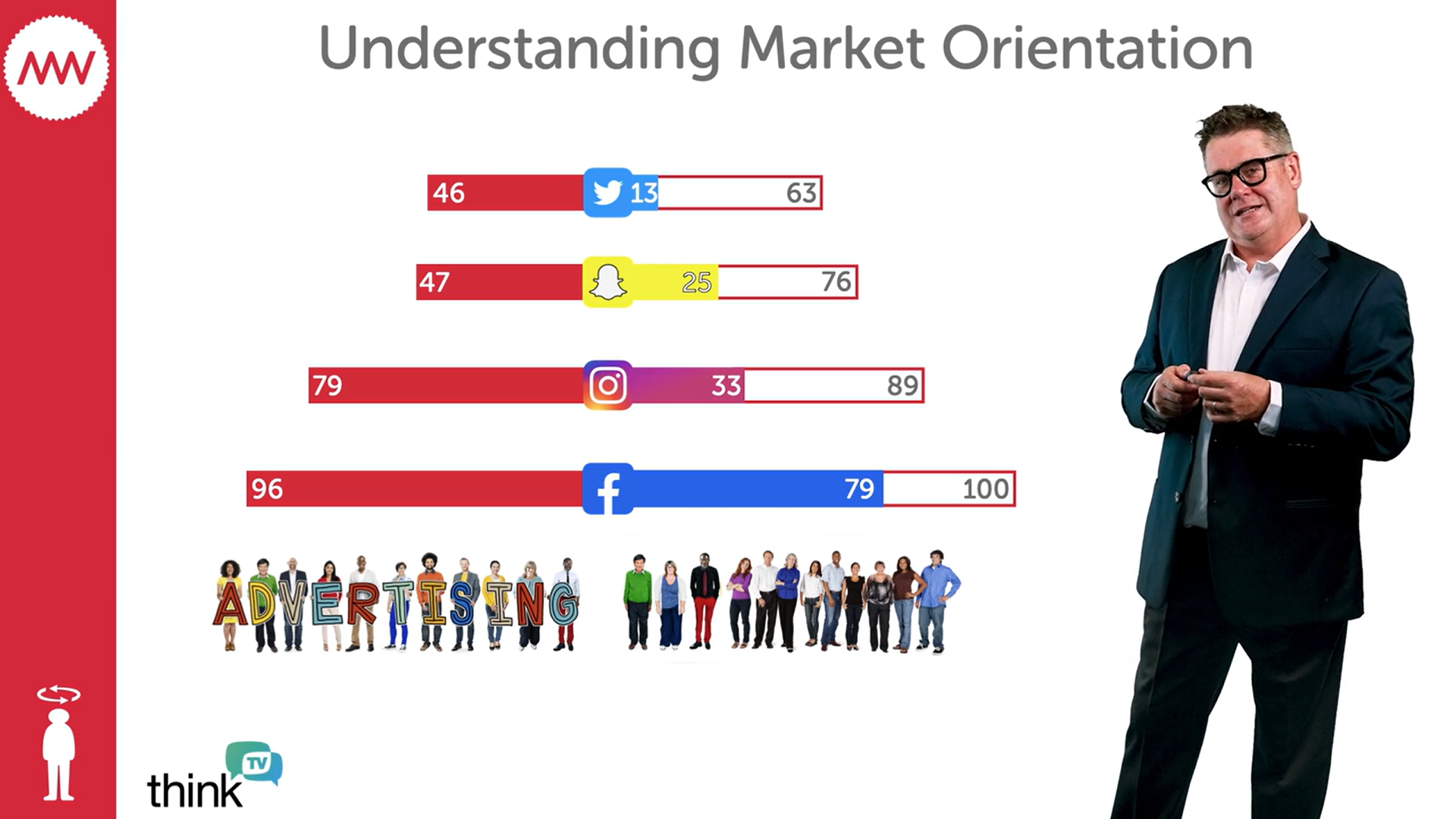
Their latest update in 2022, Adnormal Behaviour, follows the same track, with media professionals overestimating TikTok usage by more than 100%.
Researchers Andrew Tenzer and Ian Murray have done similar research, exploring the difference in personalities between the UK advertising and marketing industry versus ‘the modern mainstream’ (middle 50% of households by income). Their 2018 whitepaper, Why We Shouldn’t Trust Our Gut Instinct spotlights a hard truth: the people doling out tactical decisions often don’t know a thing about the consumers they’re trying to influence.
They took the idea further in 2020 with The Aspiration Window. The follow up paper shows that not only are we not our customer, but we also have wildly different estimations about their hopes, dreams and emotional benefit triggers. The average consumer is far less concerned about image, status and ‘standing out’ than the people selling to them would like to believe.
These studies (and many more like them) confirm that first and most important lesson in marketing: you are not the consumer. And if we build a strategy based on what we think consumers want, it will be wrong.
The enemies of market orientation
Our “prime directive” as marketers, says Mark Ritson, is to bring the voice of the customer into the organisation.
“In theory, this is a very simple message: listen to customers because you work in marketing. In practice, however, it’s something that most of us struggle with, most of the time.”
So why do we fail at this seemingly simple mission? There are the common but misguided barriers of time and cost. There’s also the fear of what market research might reveal. “Better to continue in ignorance than discover the heart of the problem” says Mark.
Ironically, seniority can also show up as a barrier to market orientation. “As experience grows, so too does a reticence to conduct market orientation work,” says Mark. “Take any young brand manager and they know nothing, so they’re very quick to embrace consumers. But as the years pass and expertise grows, it becomes harder to justify talking to customers.”
Take any young brand manager and they know nothing, so they’re very quick to embrace consumers
Another thing that can paralyse market orientation efforts is an ambiguous customer, says Mark. “Who should I be talking to?” That might be a simple question if you’re a DTC brand in a niche market. But taking Intel as an example, Mark explains how the question becomes more difficult. Is it the PC manufacturers that use Intel chips in their computers, who buy direct from the brand? Is it the retailers that are selling those products on to end users? Or is it the end users themselves and what they’re looking for when they make buying decisions?
“The short, painful but important answer to the question is … you should be talking to everyone. And in an ideal situation, your knowledge of the end user is so great, that your expertise in that area gives you market power over everyone between you and those that ultimately consume your product.”
And the most dangerous enemy of all: “Consumers don’t know what they want.” It’s true that a consumer will rarely articulate exactly what a business can do to be more successful. But by talking to lots of them, we can begin to understand common motivations, pain points or anxieties that influence buying behaviour.
“The point of market research isn’t to give us strategy,” says Mark. “The point of market research is to help us understand what’s going on – and from there we build a strategy.”
The marketing 180
Businesses tend to think of marketing as doing something ‘to’ the consumer and they forget about the other side, which is listening to consumers and feeding insights back into the organisation to maintain competitive advantage, drive growth and increase profitability. Market orientation is how we keep ourselves pointed in the right direction.
Instead of looking out from the business at consumers, we must flip our view 180 degrees and try to see through the eyes of consumers looking back at our business. Instead of looking inside-out, we look outside-in. Mark Ritson calls this “the marketing 180” and when organisations are able to pull off this manoeuvre, interesting things start to happen.
For example, people inside businesses talk about competitors, i.e. other companies offering a similar product or service. But when consumers are making buying decisions, they have alternatives. That alternative might not even come from the same category. A cinema may think its competitors are other local cinemas, but from the customer’s point of view, going bowling or even staying home and scrolling TikTok is competing for their leisure time and attention. Rather than buying a sports car, the alternative could be a luxury holiday or donating to charity – because the purchase is about signalling success, not fast motoring.
If you’re not talking to customers, those alternatives could be flanking you on either side – and you can’t adjust your strategy to overcome that threat if you’re blind to it.
If we do pricing research with consumers, we can move away from cost-plus pricing towards value-based pricing, where we’ll often discover we can charge more for our product or service. As McKinsey & Company once famously reported: “In our experience, 80 to 90 percent of all poorly chosen prices are too low.” The authors of the paper warn that by relying on cost-plus or competitor-based pricing, “companies consistently undercharge for products.”
80 to 90 percent of all poorly chosen prices are too low
When it comes to product, a good lesson in learning from the market comes from Corona, whose ‘ritual of the lime’ was entirely conceived by consumers. This initially annoyed Corona bosses, who thought their delicately balanced lager was being butchered. Today, it dominates their communications and they’ve developed a citrus-based spin-off, Corona Sunbrew.
In marketing communications, seeing through the eyes of consumers helps us remember that normal people don’t think about whether ads are digital or traditional. In fact, they’re regularly consuming several forms of media at once. This small but important shift in perspective can lead us toward a more media neutral, integrated approach.
Equally, it grounds us in the reality that advertising is just a tiny part of the marketer’s job – and the part which consumers do their very best to ignore. In our obsession with doing something ‘to’ the market, we often overlook the other ways consumers experience our brand; touchpoints “which are often far more important,” says Mark.
Better marketing begins here
Going on the journey of market orientation impacts everything we do from that point forward. Instead of doing what we think customers want, then hoping they’ll pay for it; each step of the marketing process is logically carried forward by a deep understanding of our consumers – who to target, how to position our product or service, and so on.
each step is logically carried forward by a deep understanding of our consumers
Businesses that think and operate this way are more successful. Study after study shows that companies who listen to consumers outperform those who don’t. Put simply, Mark says, “Companies that are more market oriented enjoy better consumer intelligence, which enables them to launch better products and services, price them better and communicate better… And it results in improved business performance.”
That’s not to say it will be easy. We’ll have to fight our own bias, break through organisational barriers, and delve back into our data at every turn – data which won’t always give us simple answers.
“It’s easier to stay on this side of the wall, where things are simplistic and frankly incorrect,” says Mark.
“The journey of great marketing begins with accepting that you know nothing, and the market knows everything … If you don’t start with that humility, great marketing won’t happen … Market orientation is a crucial step in your journey, because once you have it and once you maintain in, you’ll always be heading in the right direction.”
You can learn more about market orientation on the MiniMBA in Marketing. Mark Ritson takes learners on a perspective-shifting examination of how organisations can become more customer-centric, including how to measure market orientation and diagnose weak areas using the MORTN Scale. As well as how to turn the tide on competing business orientations like a product or sales orientation.
The quotes from Mark Ritson in this article are taken from Module 1: Market Orientation in the MiniMBA in Marketing.
Cover: Parradee / Adobe Stock