

Most brands think they’re customer-centric. Most customers disagree. Here’s how the MORTN Scale measures, diagnoses, and drives true market orientation across an organisation
The first lesson of the MiniMBA in Marketing is “you are not the consumer” – you don’t know what customers think, want or how they make buying decisions. Once a business accepts this inconvenient truth, they start a journey of market orientation and great marketing can begin.
Also known as customer-centricity, market orientation is a strategic marketing approach that places consumer intelligence at the heart of the business. Put simply, it’s listening to and learning from the market, then feeding those insights back into the organisation to drive strategic decision making.
That might sound painfully obvious, yet it’s something “most of us struggle with, most of the time,” admits Mark Ritson – and something that many organisations fail at. But rising to the challenge of market orientation is marketing’s most important job. Customer-centric organisations are proven to see more growth and profit over time. They launch better products and services, price them better and communicate about them better.
rising to the challenge of market orientation is marketing’s most important job
And so, our “prime directive,” says Mark, is to bring that voice of the customer into the business. That means using market intelligence within our own department (read how customer-centricity drives marketing strategy) but he’s also talking about applying those insights at an organisational level. To build a true market orientation, a company must commit to the full scope of it. It’s not as simple as doing more market research. It’s also how you irrigate that information throughout the organisation and use market intelligence to drive better performance across every function.
The idea of organisational market orientation has been kicking around since the 1980s. Over the next decade or so, following important research and analysis from Narver & Slater, Kohli & Jaworski and the prolific Rohit Deshpandé; the marketing discipline came to define a highly market-oriented company by a handful of key factors:
- Believes they exist partially or wholly to satisfy the needs of customers
- Superior consumer intelligence
- Superior competitor intelligence
- Systems in place for sharing that intelligence
- Organisational responsiveness to intelligence
In other words, as well as a belief in customer-centricity, a highly market-oriented company is operationally optimised to deliver that promise. It has a functional ability to glean more insight from the market than most other companies, and a company-wide culture of sharing and, where appropriate, strategically responding to that intelligence.
As well as proving the business value of market orientation, the academics on the frontline came up with increasingly precise ways to measure it. The best of these, according to Mark Ritson, is the MORTN Scale. “It’s shorter, it’s more practical and it was built from many of the more complex scales of an earlier era.”
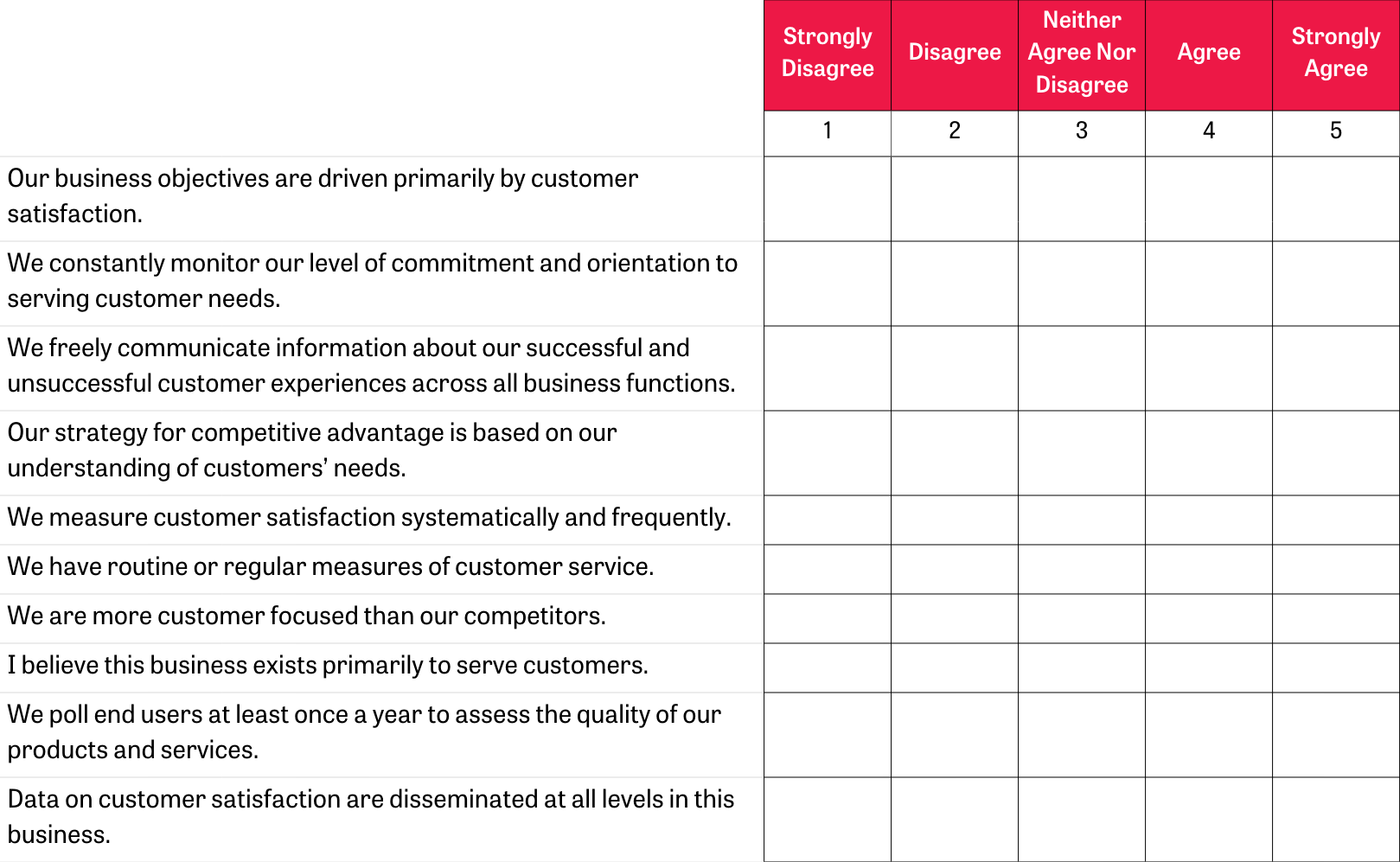
Developed by Rohit Deshpandé and John Farley in 1998, the MORTN Scale poses 10 statements, allowing respondents to rate their level of agreement on a five-point Likert scale that ranges from Strongly Disagree to Strongly Agree.
It might look simple, but that’s precisely the point. Deshpandé & Farley’s 10-item scale was exhaustively refined by testing and validating each item across multiple countries and industries. The result is a robust, practical and universal tool that is still extremely effective almost three decades on.
Designed to be filled out by all employees, a MORTN survey is run once a year and analysed by the marketing team to understand where the business is improving or where they need to do better at intelligence gathering and sharing.
“It’s a really quantitative instrument that’s been proven to measure and drive market orientation over many years,” says Mark.
Why is measuring customer-centricity important?
The MORTN Scale interrogates the three broad levels of market orientation that allow true customer-centricity to take place: Do we exist to serve customers? Are we good at generating consumer insights? How do we disseminate that information throughout the business and all its different functions?
By measuring market orientation in this way, it allows us to diagnose weak areas, create benchmarks and then, crucially, track progress across entire organisations.
“I’ve used MORTN with several clients when starting a consulting engagement, because it enables me to look at where the bottlenecks might be. More importantly, it allows me to measure things at their worst, so that in a year’s time as we begin to improve marketing – perhaps without much business results at that stage – we can at least show that the market orientation inside the company is already evolving,” says Mark.
most companies aren’t as customer-centric as they think
The other, maybe even more obvious, reason to introduce the MORTN Scale is that most companies aren’t as customer-centric as they think. Market orientation is a proper, disciplined marketing approach. Simply saying “we’re customer obsessed” won’t make it so. There need to be systems in place, dedicated resources and company-wide buy-in to pull it off.
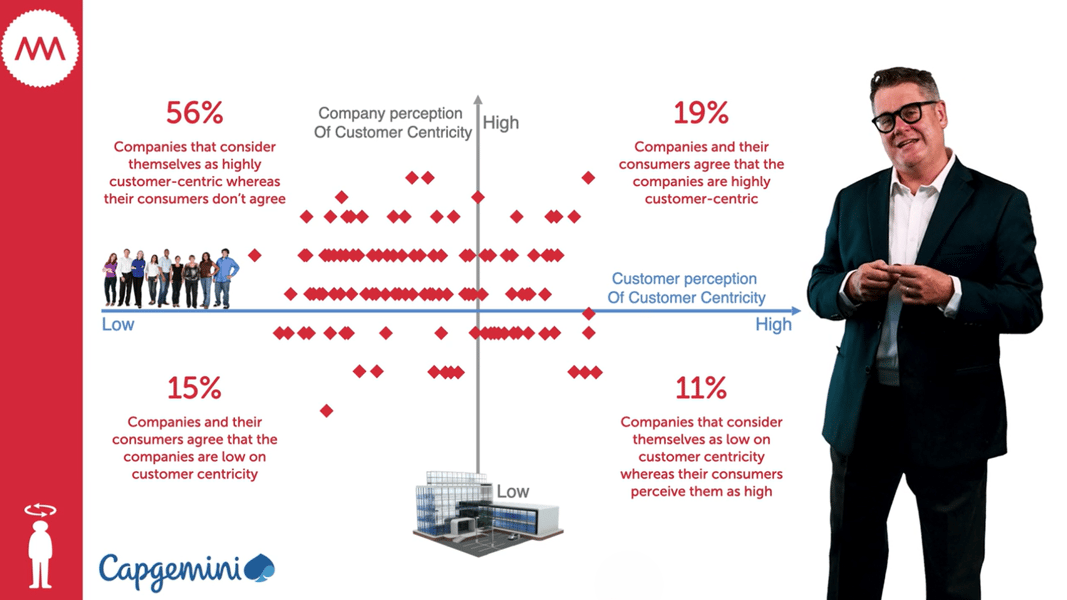
Some research from Capgemini illustrates this perception-reality gap. Looking at 125 companies across a spread of industries, most companies – 75 percent – rated themselves as ‘highly customer-centric’. However, for more than half of those companies who rated themselves highly, their customers didn’t agree.
From ‘colouring in’ to growth engine
We already know that customer-centric businesses have better business outcomes. But internally, it makes life easier too. Committing to market orientation helps get whole organisations onto the same page. Across all functions, decisions are driven by collective consumer intelligence.
Understanding the real barriers and challenges of potential customers, as well as their needs and motivations, impacts every business function – from finance and operations to web teams and front-facing customer service roles. It enables smarter resource allocation and investment, better forecasting and efficiency, and a joined-up customer journey that holds up across every touchpoint.
Across all functions, decisions are driven by collective consumer intelligence
Or as the great Peter Drucker put it: “Marketing is not only much more than selling, it is not a specialised activity at all. It encompasses the entire business. It is the whole business seen from the point of view of its final result, that is, from the customer’s point of view.”
Inside a successful market orientation, the marketing department transforms into a key driver of growth. Instead of only doing ‘to’ the consumer from their small corner of advertising and communications, marketing acts as a central source of market intelligence, feeding strategy and innovation across every pocket of the business.
Run annually, the MORTN Scale survey is a reliable, evidence-backed tool to ensure no part of the organisation slips through the cracks.
You can learn more about market orientation on the MiniMBA in Marketing. Mark Ritson takes learners on a perspective-shifting examination of how marketing teams can lead the way towards true customer-centricity, including how to turn the tide on competing business orientations like product and sales orientation.
The quotes from Mark Ritson in this article are taken from Module 1: Market Orientation in the MiniMBA in Marketing.
Cover: Natalya Kosarevich/shutterstock.com