

Marketers need to stop over complicating things and take a simple, bothist approach to positioning strategy
First thing’s first, positioning is not dead. Nor is it at war with the Ehrenberg-Bass quest for distinctiveness. In a modern, bothist approach to marketing, you need both.
Brands must first stand out and be noticed by the consumer, then through positioning – or ‘differentiation’ – stand apart to create preference, pricing power and all of the other good things marketers need to drive growth.
Mark Ritson calls this the ‘Double D’ approach to positioning: distinctiveness AND differentiation. And that’s what he teaches on the MiniMBA in Marketing.
Distinctiveness (or distinctive brand assets) is just another way of talking about brand codes – how quickly and easily do audiences recognise a brand and its assets? Logos, sounds, characters, packaging, et cetera.
While differentiation is how you position yourself to consumers: what do I want the consumer to think, when they think about my product or brand?
Both Ds serve a vital strategic function, and each plays a different but complementary role in tying together your overall strategic play. As Mark Ritson says, “we can have our cake and eat it too.”
Why bothism wins
While the concept of distinctiveness is relatively new in the marketing world, we know that it works.
Done well, and if you’ve got the budget behind you to see it through, distinctiveness is more effective than anything else at driving sales growth demand. A study by Kantar found more than 40% of sales growth is driven by how distinctive you are.
However, differentiation wins by a landslide when it comes to price. 49% of pricing power is driven by positioning (versus just 6% from brute salience). In other words, positioning “gives you the ability to charge more as we harvest that demand,” says Mark.
differentiation wins by a landslide when it comes to pricing power
Another important function of distinctiveness is that our brand codes act as a bridge between the long and the short. Sales activation ads aren’t good at brand-building, “this is what we stand for” messaging. But if a positioning already exists in the mind of the buyer – thanks to our long, brand-building efforts – our brand codes carry all of that work and investment through to our shorter-term, activation-based marketing.
Put simply: “People understand the brand quickly, then we go on to sell our product.”
Relative differentiation (positioning in a world without USP)
The earliest thinking around positioning was built on the idea of a unique selling proposition, defined by Rosser Reeves in the 1940s as “something that the competition cannot or does not offer.”
Later, Ries and Trout gave us the idea of “owning” an attribute in the market, before Michael Porter introduced differentiation in the 1980s. Porter’s differentiation is a positioning strategy that selects “one or more attributes” that buyers perceive as important and “uniquely positions itself to meet those needs.”
The problem with these models is that they’re based on uniqueness. When in reality, “there is nothing unique about your brand or anyone else’s brand,” Mark says.
“It’s a search for something that doesn’t exist. Brands don’t have unique qualities or attributes – and if they do, they’re going to be copied.”
Brands don’t have unique qualities or attributes – and if they do, they’re going to be copied
Today, Mark Ritson gives us a new positioning framework: relative differentiation. This is positioning as “more or less of something than the competition.” In this framework, we take the few things we want to say about our brand – our positioning – and make sure we do it better than anyone else.
Then we say it louder, more often and for longer, across all our different touchpoints.
“The search for uniqueness was always a pointless quest,” says Mark. “But in finding a few select variables, we can achieve relative strength and therefore relative differentiation.”
Stop overcomplicating the process
Positioning is, very simply, what we want consumers to associate with our brand. And yet it’s one of the worst afflicted areas of marketing when it comes to overcomplication and nonsense.
Positioning isn’t the end goal; it is a means to an end: getting the consumer to think two or three things about our product or service. Brand keyhole models and brand personality wheels and concentric circles and the dreaded 20-page brand book… “It’s all too much,” says Mark.
Marketers must be able to explain, in a few words, what your position is. Otherwise, how can you expect the consumer to get it?
“Work backwards,” says Mark. “What do I want them to think? Then write it down.”
How you articulate that positioning doesn’t really matter. Sephora chooses Brand DNA, Patagonia has Brand Values, Apple is guided by three tenets: Simplicity, Creativity, Humanity.
What does matter is that you choose one clear, tight articulation. And then make sure every part of the business understands exactly what you stand for, so you can be consistent across every touchpoint in getting that position through to the minds of consumers.
Think about an Apple store and their employees. You immediately know where you are without needing to see a logo, because the positioning is all there – it’s simple, creative, human.
How do you choose the right brand positioning?
Positioning is strategy and that means making choices. Not finger in the wind choices or asking your team to take a vote. There are robust marketing frameworks to help you make the right choice for your consumers, your category and your brand.
Throughout MiniMBA’s positioning module, Mark Ritson takes learners through different positioning methods, tools and their use cases.
The most elemental of these is the 3Cs model. What does the consumer want, that our company can deliver, better than or differently from the competition?
“If you can find those two, three, four things, that pass all of these three C tests, you will have a successful position for your product or service,” says Mark.
“But it’s a deceptively simple model, which most brand positionings totally fail.” Taking Starbucks’ strange mission to “nurture the limitless possibilities of human connection” as an example, Mark runs it through the three Cs test:
“Is that what the consumers at Starbucks are looking for … or are they perhaps interested in an oat latte?
“Is this something the company actually delivers upon? Have you been in a Starbucks where you’ve been nurtured with the limitless possibilities of human connection? I doubt it.”
And finally, are there other competitors that can deliver this positioning better? “Arguably, yes. Starting with most of the social media brands,” says Mark. “This, for me, is bad positioning because it completely fails the 3Cs test.”
We can also use the benefit ladder to make our positioning more compelling to consumers. For example, can we take our position from a product feature (“low prices”) to a customer benefit (“Save money. Live better”) or even an emotional association that will resonate with our audience?
Look to consumers for new positioning opportunities
Multi-dimensional perceptual mapping is a positioning tool that uses consumer data analysis to illuminate which attributes consumers associate closely (or not closely) with your brand. This is an incredibly useful method for steering you in the right direction, but also away from positioning dead ends. For example, there’s no point in trying to position on ‘the cutting edge’ if consumers consider you ‘slow-paced’ and ‘cosy’.
Perceptual maps can also open up other positioning avenues that you might not have considered. Brands aren’t necessarily restricted to associations that already exist in the minds of consumers, if they can reasonably establish a new benefit or association that passes the 3Cs.
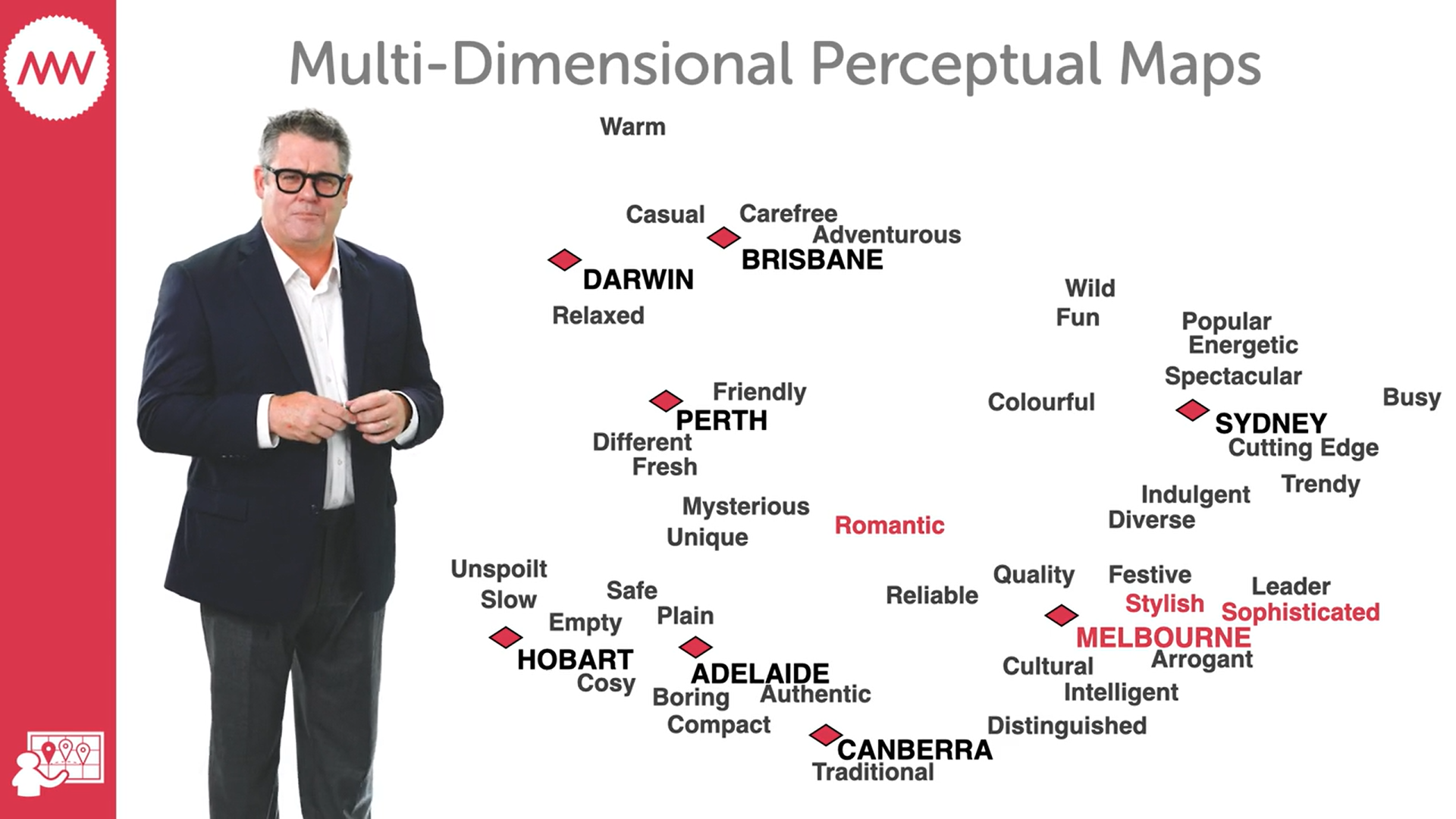
In the MiniMBA in Marketing, Mark demonstrates how Tourism Victoria used perceptual mapping to position Melbourne as a destination for domestic Australian tourists looking for a weekend away. The campaign built on existing associations with style and sophistication, while also claiming romance – an attribute with no strong association to any other major city.
In their case, they had research that shows romance is a key motivation in booking a weekend trip, so it was a smart strategic choice to go after that third attribute. Here’s how Tourism Victoria execute that position:
Again, it’s important to remember that positioning is a means to an end. How you use it is what matters. It’s how consumers experience it in your execution, across all your different touchpoints.
“Whatever positioning statement you have, you’re never going to show it to consumers. It’s not meant to be an external document,” says Mark. “Instead, you use that positioning to drive and influence every decision you make about every major touchpoint.”
We must stop overcomplicating the process and see positioning for what it is: a strategic exercise that marketers use – very effectively – to guide consumers towards choosing our brand, product or service.
You can learn more about strategic positioning on the MiniMBA in Marketing. Mark Ritson takes learners through the data behind this approach, additional case studies and further positioning tools including his own favourite – the classic positioning statement.
The quotes from Mark Ritson in this article are taken from Module 5: Positioning in the MiniMBA in Marketing.
Cover: Master1305/shutterstock.com