

A few years ago, Professor John Dawes of the Ehrenberg-Bass Institute wrote down a simple observation of B2B marketing.
According to Dawes, at any given time, only 5% of B2B buyers are in-market. 95% are not. He writes:
“Corporations change service providers … once every five years on average. That means only 20% of business buyers are ‘in the market’ over the course of an entire year; something like 5% in a quarter … put another way, 95% aren’t in the market” (Advertising effectiveness and the 95-5 rule).
Dawes notes that these buyers already have what you’re selling and won’t need a replacement for months or years. Or they’re under contract with your competitor. B2B marketers cannot ‘create demand’ in the out-of-market.
B2B marketers must therefore focus on priming those 95% with emotive brand-building advertising, so that when they enter the market (become the 5%), yours is the brand that comes to mind.
Calling it the 95:5 rule, Dawes offers his credo as a mental model, rather than a hard and fast rule. If you know the average interpurchase time of your category, you can run your own calculation. But whatever the ratio, the implication will be the same: most business customers aren’t looking to buy right now.
Once they are ready to buy and waving the company credit card around, brands that aren’t already well-rooted in the minds of those buyers will probably miss the boat.
brands that aren’t already well-rooted in the minds of those buyers will probably miss the boat
For example, a recent study of B2B buyers found that 80-90% already had a list of vendors in mind before they began the research phase – and 9/10 went on to select a provider from that day one list.
We know that rational, “buy now” sales activation has short-term impact – buyers won’t remember it months or years down the line when they do come in-market. Thus, B2B marketers should nurture the long just as diligently as the short.
Simple, right? Yet it’s worth highlighting some misapplications of the 95:5 rule to circumvent any challenges from on high. At its core, this is a budgeting decision and that usually means justifying spend to stakeholders.
Don’t fixate on the 5%
It might be true that all revenue comes from 5% of your market, but the nuance is lost without adding “…at any given time.”
We’ve seen Dawes’ rule conflated with Pareto’s 80/20 Principal (80% of results come from 20% of actions). Looked at this way, 95% of B2B advertising efforts are a waste of time and you should focus exclusively on the small percentage of buyers who might actually give you money.
Our key message isn’t that only 5% are buying. It’s that 95% aren’t buying right now. Therefore, a hefty chunk (roughly half) of your resources should be focussed on priming those 95% for when they are ready to buy, AKA long-term brand building.
Preempt ROI fanatics and short-term thinkers with a list of all the reasons why it’s a bad idea to only target that in-market 5% and hit them with everything you’ve got each quarter. For instance, that buyers prefer brands they are already familiar with (see: How Brands Grow and 82% of searchers choose a familiar brand for the first click).
Or stagnated long-term sales growth. There’s nothing better to strike fear into the hearts of CFOs than Les Binet and Peter Field’s infamous line graph:
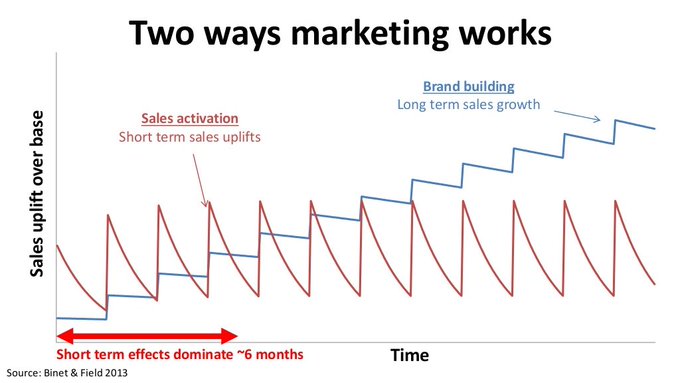
Binet & Field (2013) ‘The Long and The Short of It,’ IPA
It’s not the new long:short
Dawes’ 95:5 rule is not meant to replace or B2B-ify Peter Field and Les Binet’s seminal work in The Long and the Short of It.
Dawes doesn’t offer a proposed promotional budget split between the ready-to-buy and out-of-market. For that we defer back to Binet and Field, then apply Mark Ritson’s two-speed marketing approach.
In their paper The 5 Principals of Growth In B2B Marketing, Field and Binet update their original research to include the optimum budget split for different sectors. For B2B, this sits at 46% brand building : 54% short-term activation.
What Dawes’ rule does, however, is offer a powerful rationale as to why. Binet and Field tell us what – on average – is the most effective advertising split. Dawes gives us a reason why.
The immeasurable long becomes 95% of your potential customers
For B2B stakeholders then, 95:5 is an amuse-bouche to the idea of long:short. The immeasurable long becomes 95% of your potential customers and suddenly half the advertising budget to spend on brand doesn’t seem like such a big ask.
As Mark Ritson can testify –
“I have used the 95:5 rule this year in B2B with non-marketing senior managers and they get it. They don’t get long and short. They don’t get brand building. They don’t get any of it. But the 95:5 rule, they say, ‘Huh! I get it. We need to prepare the 95 for when they turn into the five.’ It really works.” – Mini MBA in Brand Management Q&A* (Nov ’22)
So, used as a mental model, 95:5 is a beautiful addition to the marketer’s toolkit. It highlights an important truth in rousingly simple terms.
Learn more about targeting, advertising effectiveness and how to balance long and short brand building on the MiniMBA in Marketing.
*Q&As with Mark Ritson
Biweekly Q&As are a key part of the Mini MBA in Marketing, Mini MBA in Brand Management and Mini MBA in Management – giving learners a chance to raise any questions, share their thinking on the previous weeks’ modules and glean extra insights from the course professor.
Cover: OlekStock/shutterstock.com